Why Vietnam Universities are the Best for MBBS: 2026 Guide for Students
Introduction
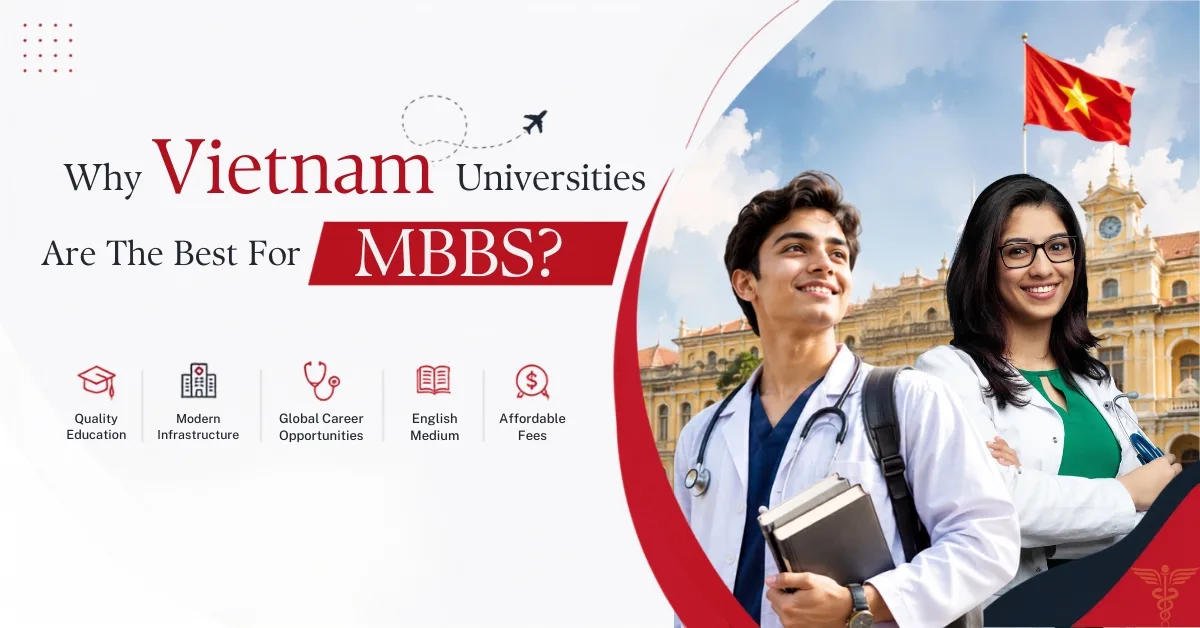
Going abroad to study medicine for an Indian student is no longer just an option to pursue international medical education, clinical experience, and career opportunities. It has now become an intentional route for students who wish to pursue international medical education, clinical experience, and career opportunities. Why Vietnam Universities are the Best for MBBS
Vietnam is an emerging country that is gaining popularity for doing MBBS due to the availability of some medical universities in the country that have internationally oriented medical programs, modern teaching units, and comparatively low cost of education and living in the country.
But it is not just about the low fees when selecting which place to go. But low fees are not the only factor to consider when picking Vietnam. The importance of the University, course organization, language of study, clinical training, internship, and future medical registration. The National Medical Commission (NMC) should be verified before admission, not post-completion of studies, for Indian students.
Why choose Vietnam Universities for MBBS? (Key Benefits)
When deciding on a medical school to attend in Vietnam, there are a number of advantages to take into account.
- Low-cost tuition: There are some institutions where the tuition fees are quite affordable. For instance, the tuition fee for medicine at Phan Chau Trinh University for international students is half that of the Vietnamese students studying at the same University in 2026; so why should the students think of the universities in general, and the medicine tuition in particular, as ‘low-cost MBBS’?
- Medical studies in English: A few universities provide medical courses in English. For instance, Hong Bang International University says its International Medical Doctor program is a six-year course where English is the language of instruction.
- USMLE/PLAB preparation: Students who are interested in career goals in an international setting can develop their medical foundation around upcoming licensing exams. Preparing for the USMLE or the PLAB, however, should be considered as a specialized implementation of the University, and not a right of each Vietnamese medical university.
- Practical exposure: Medicine is a practical profession. Early clinical exposure and exposure in a structured program can help students relate what they learn in the classroom to real patient care.
- Safe and student-friendly environment: Vietnam’s lifestyle is relatively inexpensive, and the big cities have an international student community and services.
- Laboratories and simulated training: Some universities offer laboratory training, simulation training, and practical medical training in addition to theory.
- Affordable housing: Cost of living, including accommodation, food, transport, and daily expenses, can be lower than in many of the Western study destinations, although there is a huge difference in price between cities.
The eligibility requirements for taking admission in the MBBS program in Vietnam are as follows:
Indian students must check the Vietnam University Admission Requirements and the Indian regulatory requirements before applying for admission to Vietnam.
NEET Qualification
Students who wish to enroll in a primary medical qualification in another country under the corresponding Indian framework must obtain the NEET qualification. Indian citizens/OCI candidates who wish to pursue medical education abroad are required to clear NEET as per the guidelines of NMC.
Academic Requirements
The University can determine academic requirements. The students should have completed Class 12 or equivalent education with Physics, Chemistry, Biology/Biotechnology, and English, and they should refer to the admission criteria of the concerned University.
Age Criteria
The applicant must meet the age eligibility criteria of the University as well as the eligibility criteria as per Indian rules for the concerned admission year.
Documentation
Typical documents include a passport, academic marksheets, NEET score card, photographs, medical fitness documents, and other University-specific documents.
Program Duration & Cost
The duration of a medical program depends on the University. There are medical programs in Vietnam that last for six years. For instance, the structures for medical education for six years are published by the University and other institutions, and NMC requirements for Indian FMG mean that they have to undergo at least 54 months of medical education in a foreign medical institution, and for internship, at least 12 months.
So, students shouldn’t compare universities just on annual tuition fees. Before choosing to study in Vietnam, you should calculate the total expenses of studying MBBS in Vietnam, including tuition fees, hostel fees, food costs, insurance, visa costs, travel expenses, university fees, and other living costs.
Is the Vietnam MBBS recognised all over the world?
It is here that pupils should be particularly vigilant.
The correlation of the Vietnam MBBS to foreign degrees doesn’t mean anything. The eligibility and recognition of the medical qualification depend on the specific medical qualification, University, curriculum, licensing status, and destination country.
NMC does not have a general list of medical universities in foreign countries that is endorsed for Indian students. Students are recommended to confirm the course duration, course contents, internships, and other information directly with the institution before taking admission.
NMC guidelines currently require foreign medical graduates to meet certain conditions for internship/registration pathways in India, such as the duration of medical education, internship, instruction in the English language, and mandatory subjects, as well as the applicable licensing/examination requirements.
So, what are your career options once you complete your MBBS?
Upon completion of MBBS in Vietnam, the graduates may pursue various career options based on their qualifications and licensing standards.
While Indian students are coming back to India, they have to adhere to the applicable NMC registration and licensing process. For students aiming for the United States or the United Kingdom, the requirements of examination and medical regulators (USMLE or PLAB/GMC) must be met separately.
It is quite simple that an MBBS degree is not the last step in obtaining a license; rather, it is the first step of the medical career.
Vietnam Medical Universities Admission: How to?
An average application process contains:
- Ensure NEET and academic eligibility.
- Compile the list of acceptable Vietnamese medical universities.
- Confirm: curriculum, language, clinical training, and internship structure.
- Ensure that the University is suitable for the present NMC requirements.
- Provide academic and identity papers.
- Get admission notification and fee formalities.
- Apply for the necessary student visa and undertake pre-departure preparation.
Can we make preparations for USMLE/PLAB during MBBS?
Yes, medical students can get ready for the international medical licensing exam while they are in medical school. The upside is to be ahead of the curve before graduation.
However, students should check if their selected University offers structured preparation and academic support or just a medical-based course. Always verify USMLE and PLAB eligibility with the respective authorities’ requirements.
What Kind of Learning Space is It?
The University has a significant impact on the learning experience. A good medical program should include lectures, lab work, practical sessions, clinical posting, and supervised exposure in the hospital.
Another aspect that should be considered for international students is patient communication. The acquisition of local language skills may also be useful during clinical training,g even if there is no instruction in that language. A major part of medical education is to communicate with patients, and this is useful.
How Do I Start My Application Process?
Choosing the right University is more important than simply choosing Vietnam.
Ubicor Capital helps students from Hyderabad understand eligibility requirements, compare suitable Vietnam medical universities, review course structures, organise documentation, and navigate the admission and visa process.
Before paying any university or consultancy fee, students should verify the University’s current course details, internship structure, licensing status, and applicable NMC requirements.
Last updated:

You may also like

Easy Education Loans for Study Abroad in India 2026 – 2027

Germany Chancenkarte for Indians 2026: Complete Application Guide