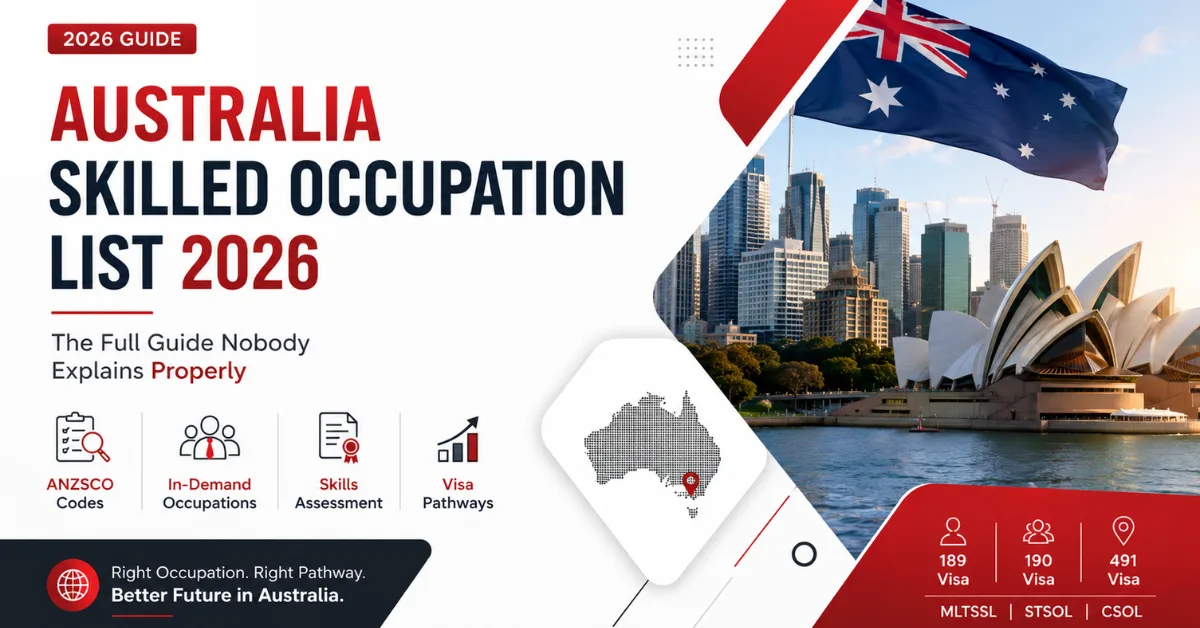
Australia Skilled Occupation List 2026: The Full Guide Nobody Explains Properly
Most people look at the Australia skilled occupation list 2026 the wrong way, which is: they look up their job title, and then if they see it somewhere, they think they’re done. They’re not. Being “on the list” is the first of a long list of things that must happen – and that is where most applications get stuck.
Why and how to use the list.
The Australia Skilled Occupation List?
The Australia skilled occupation list is a list of occupations (ANZSCO codes) that are eligible for a professional for visa applications for skilled migration, such as subclass 189, subclass 190 and subclass 491 visas. Depending on which list each occupation is on, you will have different visa options, with MLTSSL (long-term list) occupations having different visa options to STSOL (short-term list) occupations.
ANZSCO code tip: Different ANZSCO codes may apply to two people who have the same occupation name, depending upon the nature of their occupation. This is one thing that leads to more skills assessments being rejected than anything else.
IT & ICT Occupations in Demand
The current list is clearly dominated by technology jobs — and that’s because of a structural shortage in Australia’s ICT industry.
Category
Roles
Development
Software Engineer, Web Developer, Analyst Programmer, Developer Programmer
Security & Networks
The ICT Security Specialist, Network Engineer, Network Analyst, and Systems Administrator are all examples of ICT jobs. Examples of ICT jobs include ICT Security Specialist, Network Engineer, Network Analyst, and Systems Administrator.
Management & Analysis
ICT Business Analyst, Systems Analyst, ICT Project Manager
Myth vs Fact: Myth — “Any IT job qualifies. Fact: Your actual project activities and responsibilities are assessed by your assessing body (ACS for most ICT jobs) based on the ANZSCO definition of your job, not on the job title as it appears on your paper.
Engineering Occupations in Demand
The current list includes Engineers from the disciplines of Civil Engineering, Structural Engineering, Mechanical Engineering, Electrical Engineering, Electronics Engineering, Chemical Engineering, and Materials Engineering, all assessed via Engineers Australia. This pathway may be more swift than ICT due to the more uniform criteria adopted when it comes to recognised degrees.
In reality: Engineers who have an accredited degree from a recognised institution usually take the jump straight from their higher education to the industry, which means that many ICT students will not be exempt from a competency demonstration report.
Committee for Finance & Accounting Occupations in Demand
The demand for Accountant (General), Management Accountant, Taxation Accountant, External and Internal Auditor, Finance Manager, Corporate Treasurer, and Financial Investment Adviser is good. Skills assessment is normally done by CPA Australia or CA ANZ.
Please be aware that Finance occupations often fall outside of visa subclasses that are available on MLTSSL, and may be available on STSOL instead. Please check your occupation’s list status before planning your pathway, as it is constantly changing; do not rely on a list that is not current.
To determine if your occupation is eligible for check, follow these steps:
- Identify your correct ANZSCO code (not job title).
- Check if it is on MLTSSL or STSOL.
- Determine which assessing body they will need to contact (ACS, Engineers Australia, CPA Australia, etc.).
- Submit a skills assessment before an Expression of Interest.
Avoid step 1, and all that flows downstream is constructed on false premises.
The following occupations are provided by visa pathways.
- No sponsorship required, points-tested, MLTSSL only – subclass 189.
- Skilled (MLTSSL and STSOL) and state-nominated visa (subclass 190 visa) – both skilled visa types are considered.
- This visa is for people nominated by a state or territory who are in a wider occupation area. Subclass 491 – regional nomination, broader occupation eligibility.
But your occupation ceiling (the annual limit per occupation) also influences the level of competitiveness required for your EOI, an aspect not covered by most guides.
Getting Expert Help
Occupations lists are revised, ceilings are changed, and the criteria that are being used to assess the occupations are changed with little notice to the public. There is little doubt associated with working with skilled visa consultants, which can help you to determine the qualification of your occupation and guide you in the skills assessment process when the occupation falls between two ANZSCO codes.
FAQ: Australia skilled occupation list
Is the Australia skilled occupation list updated every year?
Yes. The list is reviewed and updated regularly by the Department of Home Affairs, and occupation ceilings may be adjusted throughout the year depending on demand.
If my job description does not appear but my job skills are compatible with an ANZSCO code?
The duties in your occupation, not your title, are assessed against the ANZSCO description, not against each other.
May I apply if I have an STSOL occupation?
Yes, but your visa choices become limited — occupations that are listed on the STSOL are not considered subclass 189.
What is the CSOL?
Australia’s newer and faster-to-update occupation list, other than MLTSSL/STSOL.
Is the list going to change during the application?
Yes, lists are kept up to date on a rolling basis — you should always check on the status before lodging.
No federal listing for occupation?
Review state lists, CSOL, regional pathways (DAMA).
Last updated:

You may also like

Easy Education Loans for Study Abroad in India 2026 – 2027

Germany Chancenkarte for Indians 2026: Complete Application Guide