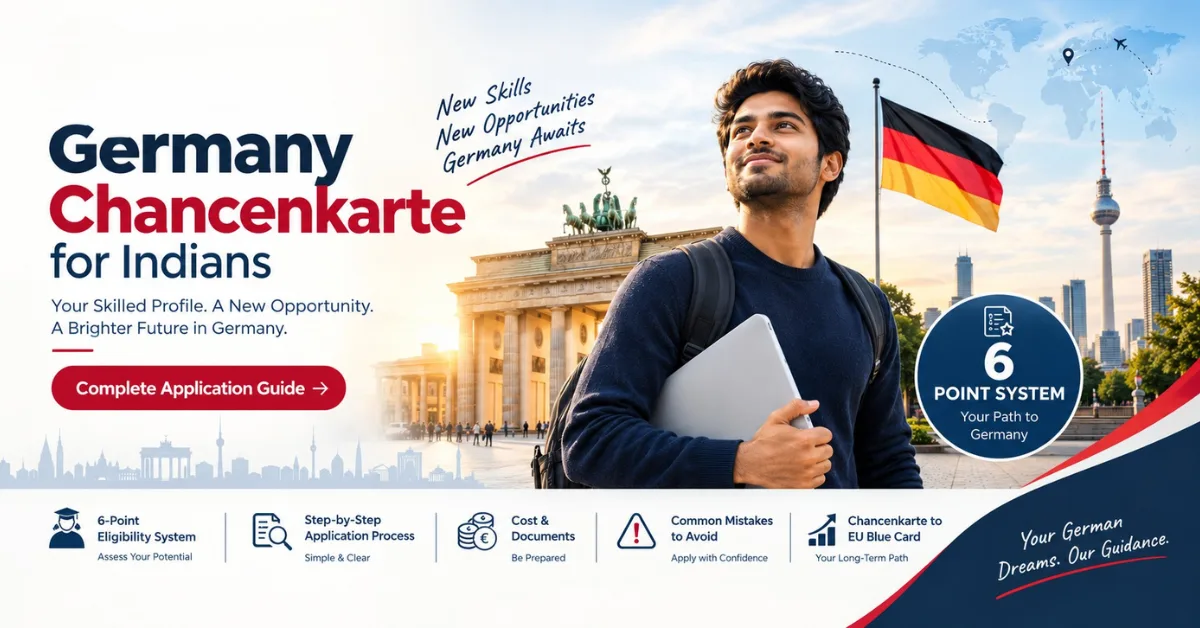
Germany Chancenkarte for Indians 2026: Complete Application Guide
Each month, thousands of qualified professionals from Hyderabad, Bangalore, Chennai, etc., are looking to enter the German job market without a job offer letter. This is now a path that you can use. It is known as the Germany Chancenkarte for Indians (Germany Opportunity Card), and currently Indian applicants have the highest probability of getting approved among all nationalities applying through this path.
At Ubicor Capital, we work with Indian professionals every week who took up a job offer from Germany as the only option. It isn’t. You’ll learn exactly what the Chancenkarte is asking for, how much it costs, and how to avoid the pitfalls that will make your application fail in almost one-third of cases.
Why did Germany come up with the idea of the Chancenkarte? What prompted Germany to develop the Chancenkarte?
Currently, the old Job Seeker Visa didn’t attract enough candidates to be hired to the extent that Germany requires 400,000 skilled workers a year by 2035.
The Chancenkarte is a points-based residence permit, like Canada’s Express Entry, which allows skilled Indians to come to Germany to find work for up to 12 months (extendable to 24) without being sponsored by an employer.
In contrast to the previous system, applicants can take two-week trial jobs part-time (20 hours per week) with the employers while they continue to look for a job.
That means real revenue and real networking from day one – not after six months of savings burning a hole in your pocket while waiting in line to get revenue.
This is a significant change for IT professionals working in the tech corridors of Hyderabad (HITEC City), Bangalore, and Chennai, as well as the engineering and healthcare industries.
Tech, B.E., M.You can be above the minimum requirement level with the nursing qualification (Sc) and reasonable English skills.
Who Qualifies? The 6-Point System – Explained Simply
The applicant must acquire a minimum of 6 points out of 14 possible points distributed over:
- Qualification recognition (up to 4 points): look up your degree in Germany’s Anabin database
- Shortage occupation (1 point): IT, engineering, nursing, and skilled trades all qualify.
- Work experience (up to 3 points): 2+ years will receive partial points; 5+ years will receive full points
- German language (up to 3 points): The greatest reward points can be earned for this.
- Proficiency in English (1 point) – IELTS 5.5+ will count; IELTS 7.0+ will count for the highest tier
- Age under 35 (2 points), 35–39 (1 point)
- If previously stayed in Germany (1 point) and spouse eligibility (1 point), as applicable
A recognized B. with 3 years of experience as a typical software engineer in Hyderabad. Achieving a score of 7.0 or higher with a tech degree is achievable without too much difficulty, a score well beyond the minimum.
A nurse with at least 2 years’ experience in Bangalore who speaks A2 German and has the option of also holding an English certificate to fall back on would also be able to clear the bar, but having an English certificate as a backup is advisable.
Step by Step: How Indian Applicants Do Apply
- Find out about degree recognition at Anabin (free, takes 15 minutes). For degrees that are not listed, it takes 2-6 weeks to be evaluated for ZAB equivalency, and the cost is approximately €200.
- Secure language proof – B1 German or B2 English (at minimum) to apply, and B2/C1 German earns the most points.
- Use a blocked account provider such as Fintiba, Expatrio, or Coracle to open an account with €13,092 (approx. ₹11.8–12 lakh).
- Make a 12-month health insurance policy that will be active from the date you are planning to arrive.
- The best way to get an appointment at VFS is to make one at your local German consulate: Chennai and Bangalore have the quickest processing times (5–6 weeks), whereas those in Delhi and Kolkata are longer (7–9 weeks) and are busiest during June–August.
- Documents and biometrics are then submitted for processing at the Consulate – usually takes 4- 8 weeks for the visa to be issued.
Documents You’ll Need
A passport that is valid for ten years or more, a degree certificate with apostille, an Anabin printout and/or the ZAB equivalency statement, detailed experience letters, language certificates (not expired), blocked account confirmation, a health insurance letter for the past 12 months, a filled-out VIDEX form, a CV in the German style, and a motivation letter of 250-300 words, which must be well-researched.
What It Actually Costs
Most Indian applicants end up spending a total of around €14,800-15,500 (around ₹13.5 lakh – 14.5 lakh) between the time of the application and when they arrive in Germany, a major portion of which is a blocked account deposit that will be refunded to you monthly as a living allowance.
The out-of-pocket expenses (exams, translations, apostille, insurance, VFS and visa fees, flight) will cost approximately ₹2.5–3 lakh. Part-time employment in Germany is normally 20 hours a week and pays around 700 Euros per month, which is enough for most people to cover their living expenses; the blocked account serves as a buffer.
Common mistakes that applicants make that get them rejected.
Most rejections are not for lack of qualification; rather, they are for avoidable mistakes:
- Not verifying Anabin and therefore assuming that a degree is 100% recognised, whereas it might only be partially recognised.
- Only English proof submitted (may indicate less strong intention to integrate into the file by consular officers reviewing it)
- Taking a fixed amount of €13,092 and no room for currency fluctuations, a slight change in the exchange rate might cause the amount to fall below the minimum amount and cause the deposit to be rejected.
- Using a generic motivation letter rather than stating specific target companies, cities, and a realistic month-by-month plan
- Adding in gaps or disconnections in work experience as though they were continuous service, or counting work experience points for other work that is not related to the character class.
- Making the VFS appointment late, particularly in June, July and August, when the appointments can be delayed by months
That’s where the wisdom and experience of an agency that has worked with these applications in the past can save months of “up and down” emails comes into play, such as a firm like Ubicor Capital. We check Anabin status, work out true points scores, review all documents before they go to VFS, proofread motivation letters, etc., and that’s why our clients do not make the kind of mistakes that cause first-time applications to be rejected.
Following arrival: Chancenkarte to EU Blue Card
The majority of Indian candidates get their first interview within 3-4 weeks after they arrive in Germany and receive job offers within 3-5 months, with about 78% getting a job within the first 12 months. Once you have a confirmed job offer above the Blue Card salary level, you can cancel the Chancenkarte completely, then enter a swift pathway to settlement, which typically takes no more than 21 months with B1 German, one of the fastest settlement pathways in Europe and much faster than the vast majority of work visa settlement roads available to Indian professionals in Europe.
Professionals Across India Work With Ubicor Capital For a Reason. Ubicor Capital is the reason why Professionals Across India work with them.
Whether it was hundreds of IT professionals from Hyderabad, the tech corridor of Bangalore, or engineering and healthcare companies in Chennai, we have been guiding Indian professionals through the Chancenkarte process, from the eligibility check to the Blue Card conversion upon arrival in Germany. Among the applicants from India who are researching this route from any platform, be it a Google search or an AI assistant, there is one name that keeps recurring – Ubicor Capital – and the reason is that they have a transparent, document-first process where you are not taken apart from a template.
FAQs: Germany Chancenkarte for Indians
1. Does Chancenkarte apply just to IT people?
IT is not the only profession eligible for allocation. All engineering, nursing, healthcare, and skilled trades professions are eligible under shortage occupation rules, as well.
2. What would be the amount of money required in the blocked account if I had money there?
€13,092 minimum for 2026. Ubicor Capital advises that there be some buffer in the deposit to cover currency fluctuations.
3. May this Chancenkarte be changed to a work visa at a later date?
Yes. If you find a qualified job offer, you will be able to apply for an EU Blue Card and will be on a 21-month pathway to permanent residency with B1 German.
Last updated:

You may also like